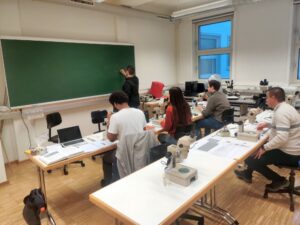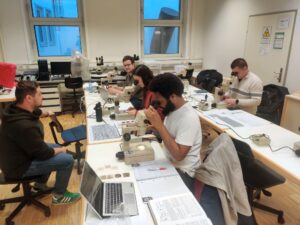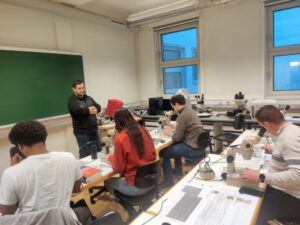
My most positive academic experience during the CEEPUS teaching activity at the Montanuniversität in Leoben was the delivery of the course “Late Paleozoic and Mesozoic microencrusters and microbialites of the Tethys Realm” to a highly committed small, international group (Austria, Nigeria, Kosovo, Romania) of MSc and phD students in geology and paleontology. The theoretical instruction allowed for an in depth presentation of microencruster diversity, microbial fabrics, and their biostratigraphic and paleogeographic significance across the Late Paleozoic and Mesozoic, while the practical training (microscope investigations) provided a rigorous tool for applying these concepts through thin section analysis, case studies, and microfacies interpretation. Students demonstrated a good level of analytical precision in identifying diagnostic features of microproblematic organisms, distinguishing microbial textures, and evaluating the role of microencruster–microbialite frameworks in shaping reef fabrics and carbonate platform evolution. Their ability to integrate small scale petrographic observations with large scale paleoenvironmental and paleogeographic reconstructions—particularly within the context of Western Tethyan carbonate systems—was especially noteworthy. The collaborative nature of the practical sessions, where students synthesized multiple options to interpret platform dynamics, environmental stress indicators, and the implications of major geological events, created a highly stimulating academic environment. This mix of advanced topics, rigorous methods, and active student involvement made the experience especially rewarding and underscored the value of CEEPUS mobility.
Prof. Dr. George Pleș